
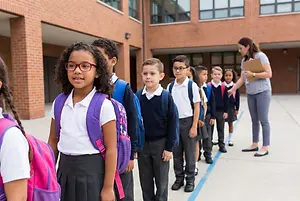
As backpacks, school supplies, and new schedules take center stage, one important item deserves a place on your family’s back-to-school checklist: a comprehensive eye exam. From preschool through high school, clear and comfortable vision supports reading, seeing the board, using classroom technology, participating in sports, and feeling confident throughout the school day.
Scheduling an eye exam before classes begin also gives your family time to address potential concerns before academic and visual demands increase.
Childhood Myopia Is Becoming More Common
Myopia, or nearsightedness, makes distant objects appear blurry while nearby objects remain clearer. It usually develops when the eye grows too long from front to back, causing light to focus in front of the retina rather than directly on it.
A recent global review estimated that approximately one-third of children and adolescents have myopia. Researchers projected that more than 740 million children and teens could be affected worldwide by 2050.
Myopia is not simply a matter of needing stronger glasses. It frequently progresses as a child grows, meaning the prescription may continue to increase over time. Greater amounts of myopia are associated with higher lifetime risks of retinal detachment, glaucoma, cataracts, and myopic macular degeneration. Detecting changes early creates an opportunity to monitor progression and discuss proactive care.
Why Are More Children Becoming Nearsighted?
There is no single cause of childhood myopia. Genetics matter, so children with one or two nearsighted parents may be more likely to develop it. Environmental and behavioral factors also appear to play a role.
Research has found an association between myopia and longer periods of digital screen use and other close-up activities. More time outdoors, meanwhile, is associated with a lower likelihood of developing myopia, although outdoor time alone may not prevent progression in a child who is already nearsighted.
Parents do not need to feel guilty about homework, reading, or necessary technology use. Instead, encourage regular visual breaks, create comfortable working distances, and make outdoor play part of the routine. Most importantly, keep regular eye exams on the calendar so vision changes can be identified rather than guessed at.
Vision and the Classroom
Children may not realize their vision has changed because blur can develop gradually. Some compensate by moving closer, copying information from classmates, avoiding distance tasks, or losing interest in activities that feel visually difficult.
Difficulty seeing the board can affect classroom participation, while an uncorrected vision problem may make sustained reading and concentration more challenging. Vintage Optical’s pediatric eye care is designed to evaluate visual clarity as well as focusing, tracking, eye coordination, and overall eye health.
Parents should watch for signs such as:
-
Squinting or closing one eye
-
Sitting very close to televisions or other screens
-
Holding books or devices unusually close
-
Frequent headaches or eye rubbing
-
Difficulty seeing the classroom board
-
Avoiding reading or other detailed work
-
A noticeable decline in classroom performance or confidence
These behaviors do not always mean a child has myopia, but they are good reasons to schedule an evaluation.
Why a School Screening Is Not Enough
School vision screenings play a useful role in identifying some children who may require further evaluation, but a screening is not the same as a comprehensive eye exam. Screenings are generally brief and often concentrate on distance visual acuity. Children who do not meet screening standards are referred for a more complete professional examination.
A comprehensive pediatric eye exam provides a more detailed assessment of prescription, eye health, focusing, tracking, coordination, and how well the eyes work together. It can detect myopia and other concerns that may not be obvious to a parent, teacher, or child.
Early Detection Creates a Plan
When an exam identifies myopia, the Vintage Optical team can establish a baseline and monitor how the child’s prescription changes over time. If progression is detected, parents can learn whether proactive myopia management may be appropriate.
The practice offers individualized myopia care based on factors such as the child’s age, prescription, visual needs, and lifestyle. Specific treatment options can then be discussed during a dedicated consultation rather than taking a one-size-fits-all approach.
Schedule Before the Back-to-School Rush
A new school year is a natural time to make sure your child is seeing clearly and comfortably. Whether your child has never received a complete eye exam, recently began wearing glasses, or has a prescription that keeps increasing, an early evaluation can provide useful answers and a plan for the year ahead.
Schedule a comprehensive pediatric eye exam with Vintage Optical in Morton, IL, and take a proactive step toward your child’s classroom success and long-term eye health.