
If regular contact lenses feel uncomfortable, move around too much, or fail to give you stable vision, you may assume contacts simply are not an option. For some patients, however, the issue is not contact lenses in general. It is that their eyes need a more customized lens design.
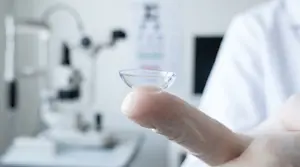
At Vintage Optical, scleral lenses may be recommended for patients with severe dry eye, irregular corneas, or contact lens challenges. These lenses are larger than standard contacts and are designed to create a more stable, comfortable fit for the right candidate.
How Scleral Lenses Can Help Dry Eye
Dry eye can make contact lens wear difficult, especially when the surface of the eye feels irritated or exposed. Scleral lenses may help because they hold fluid between the lens and the eye.
As Dr. Paul Velting explained, “Scleral lenses can preserve an amount of saline solution on the surface of the eye for the entire day.” This fluid layer may help protect the cornea and reduce dryness-related discomfort for some patients.
This does not mean every dry eye patient needs scleral lenses. However, for patients with more severe symptoms or difficulty tolerating standard lenses, they may be an important option to discuss.
Why They May Feel More Comfortable
Scleral lenses are different from soft contact lenses because they do not sit directly on the cornea. Instead, they rest on the white part of the eye and vault over the front surface.
Dr. Velting noted that, in many cases, scleral lenses can be more comfortable than normal contacts because “they don’t touch the cornea.” The fluid reservoir between the lens and the eye can also help create a smoother wearing experience.
Because the lens is larger, the eyelids may interact less with the lens edge during blinking. That can help some patients experience better stability throughout the day.
A Solution for Active Patients
Scleral lenses may also benefit people whose regular contact lenses move too much during sports or active routines. A more stable lens can be helpful for patients who need consistent vision while moving, working, exercising, or participating in outdoor activities.
This can be especially valuable when standard contacts shift, dry out, or fail to stay centred during activity. A specialty lens evaluation can help determine whether scleral lenses are appropriate.
What the Fitting Process Involves
A scleral lens fitting is not the same as a basic contact lens exam. Your optometrist must make sure the lens edge fits properly on the sclera and that the middle of the lens does not touch the cornea.
The fitting also includes training. Patients learn how to insert the lens with enough saline solution so the fluid layer sits properly between the lens and the eye. This step is important for both comfort and lens performance.
Schedule a Specialty Contact Lens Exam in Morton
Scleral lenses can be a helpful option for people who have been told their eyes are hard to fit, who have severe dry eye, or who struggle with unstable standard contacts. The best way to know if they are right for you is through a personalized contact lens evaluation.
Schedule a specialty contact lens exam with Vintage Optical in Morton. Your optometrist can review your symptoms, assess your eye shape, and help determine whether scleral lenses may support clearer, more comfortable vision.
Scleral Contact Lenses FAQs
Can scleral lenses help dry eye?
- They may help some patients by holding saline solution against the eye throughout the day, which can protect and hydrate the cornea.
Are scleral lenses comfortable?
- Many patients find them comfortable because they vault over the cornea and rest on the white part of the eye.
Who is a good candidate for scleral lenses?
- Candidates may include patients with severe dry eye, irregular corneas, keratoconus, or contact lenses that move too much during activity.
Is scleral lens fitting different from regular contacts?
- Yes. It requires detailed measurements, careful evaluation of the lens fit, and training on how to insert and care for the lenses.